DyMESH Overview
What DyMESH is
DyMESH — Dynamic Mechanical Shell — is a general, three-dimensional method for simulating collisions. The exterior surfaces of the vehicles and/or objects (collectively, bodies) taking part in an event are discretized with a triangular mesh. When two bodies interact, the meshes inter-penetrate; DyMESH detects that penetration, deforms the meshes to enforce a no-penetration condition, and computes collision forces at the nodes of the deformed mesh. The deformation of the mesh is the damage (crush) profile, and the same mesh is used both for the physics and for the visual display, so damage is visualized directly.
The collision forces DyMESH produces are combined with the other external forces acting on each vehicle and the equations of motion are then solved. In short:
Collision forces at the nodes of the deformed mesh are computed and combined with other external forces to solve for the motion of the vehicle or object.
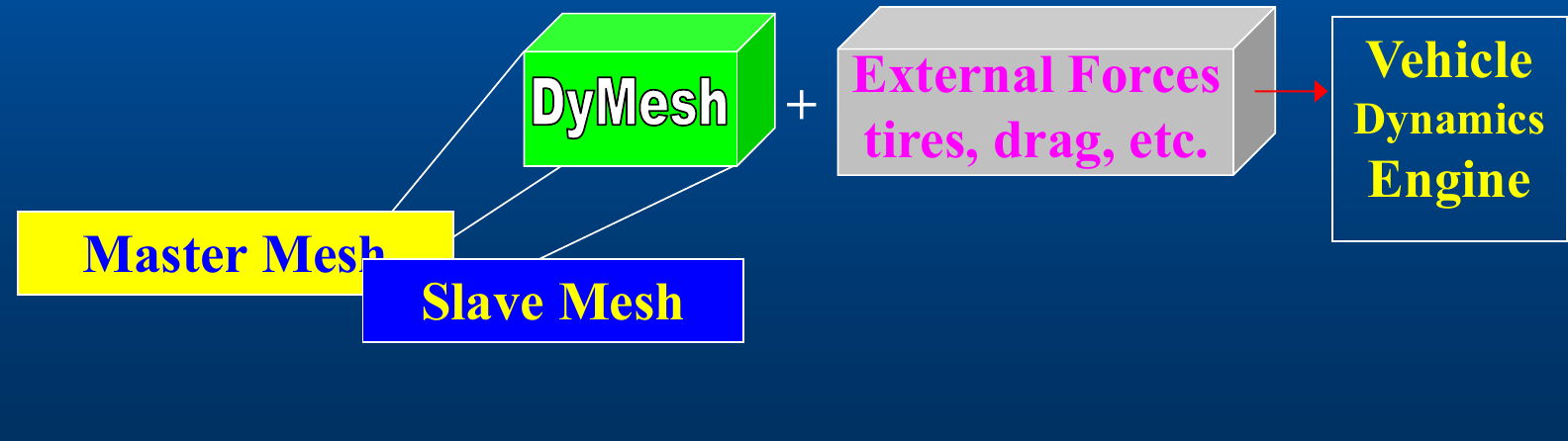 Figure: block diagram — Master Mesh + Slave Mesh feed "DyMesh", which is summed with "External Forces (tires, drag, etc.)" into the Vehicle Dynamics Engine.
DyMESH is integrated into a six degree-of-freedom vehicle dynamics model (SIMON). It is not a stand-alone code; it supplies the impact forces and moments that the host dynamics model integrates each time step.
Why DyMESH (vs. 2-D impulse-momentum methods)
DyMESH goes beyond the existing two-dimensional methods for vehicle collision simulation and allows the potential for more accurate simulations. Because it is fully three-dimensional and force-based, it can represent phenomena that planar, impulse-momentum collision models cannot:
- Non-uniform crush in the z (vertical) direction.
- Override and underride.
- Rollover.
Key distinctions:
- It is a collision simulation, not an idealized impulse-momentum method. Forces are developed continuously through the contact from the mesh deformation, rather than being resolved as a single instantaneous impulse.
- DyMESH simulations are interactive, running in a number of minutes on a typical workstation.
- DyMESH does not require the expense of generating a complex, three-dimensional, finite-element-like mesh. The user is not concerned with meshing the vehicle — the display mesh already present in the vehicle geometry is what DyMESH uses.
Where DyMESH sits in HVE / which models use it
DyMESH is the collision engine invoked by HVE's simulation models — primarily SIMON, and also available to EDSMAC4. It is enabled and configured per event through the DyMESH Options dialog (Options menu). When DyMESH is enabled, the host model calls it each collision time step for every interacting pair of bodies; the returned forces and moments are added to the vehicle's force system before the equations of motion are integrated.
DyMESH can also compute contact against the environment (terrain / fixed objects) when the Include Environment option is selected, and — as of Version 3 — against the individual wheels of a vehicle (see Version 3).
(updated: In the current code DyMESH is a licensed feature gated by
FeatureMgr::GetDyMesh(); the DyMESH Options dialog refuses to enable it without
a license.)
History
DyMESH has a long development lineage at EDC:
| Date | Milestone |
|---|---|
| 6/98 | Development begins |
| 1/99 | Prototype code, proof-of-concept |
| — | Published: SAE 1999-01-0104 and 2000-01-0844 |
| 6/99 – 1/01 | Port to HVE |
| 1/01 | SIMON/DyMESH prototype |
| — | Commercial development |
| 5/04 | Commercial release |
| 2/08 | Major update |
| 12/11 | Major update |
| 1/18 | Major update — improvement to the contact algorithm: Vertex Displacement (Crush Depth) |
The 2/08, 12/11 and 1/18 updates correspond to the modeling improvements that define DyMESH Version 2 (improved accelerations, crush-depth simulation / general damage profile, and restitution) and Version 3 (user-defined third-order force-deflection curve fit, and the DyMESH Wheels collision model).
(updated: The current source implements DyMESH with selectable Version 3 and
Version 4 behavior — the DyMESH Options dialog exposes "Version 3" and
"Version 4" radio buttons, and Event.h carries a VersionNo field. Version 4
additionally enables the "pushback reduction" restoration refinement
(UsePushbackReduction = (VersionNo == 4) in DyMeshInitialize). The 2026 decks
describe the model through "Version 3"; Version 4 is a further code-level
refinement not covered by the slides.)
Source: DyMESH Collision Simulation (2026 HVE Forum) — organized and verified against DYMESH.H / Dymesh.cpp, 2026-07-05.
← Previous: DyMESH Reference Manual | Index | Next: DyMESH Collision Model →